Sticking Information in Plain Sight: Encoding and Detecting Hidden Stickers in the Real World
European Conference on Computer Vision (ECCV), September 2026
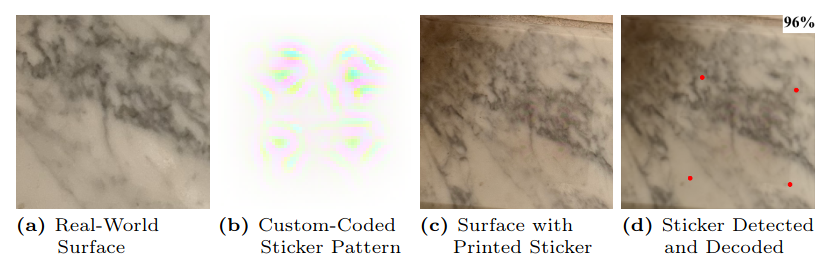
The sticker pattern (b) was generated
by feeding in the image of the real-world surface (a) and a random secret message.
The sticker was then printed and applied to the real-world surface to create (c). The
image of the surface with the printed sticker was then sent through our localizer to
determine the location of the sticker in the image. The predicted location was fed to our
decoder and the decoded secret was returned with 96% accuracy — enough to recover
the message after BCH error correction with 56 message bits and 40 parity bits.
Abstract
While there are many techniques (e.g., QR codes) that convey information via visual patterns, some applications would benefit from using imperceptible patterns. We present a method for designing subtle code-conveying patterns that can be printed on transparent sticker paper and applied to real-world surfaces. An image of a scene with an encoded sticker can be captured and the sticker localized and decoded. Thus, our stickers, while mostly unobtrusive to the human eye, are detectable and decodable to our model. We jointly optimize the encoder, localizer, and decoder end-to-end, balancing imperceptibility and accuracy.
Paper
Video
- Overview video on YouTube
Links
- Dataset on Github
Citation
Christina Shatford and Szymon Rusinkiewicz.
"Sticking Information in Plain Sight: Encoding and Detecting Hidden Stickers in the Real World."
European Conference on Computer Vision (ECCV), September 2026.
BibTeX
@inproceedings{Shatford:2026:SII,
   author = "Christina Shatford and Szymon Rusinkiewicz",
   title = "Sticking Information in Plain Sight: Encoding and Detecting Hidden
      Stickers in the Real World",
   booktitle = "European Conference on Computer Vision (ECCV)",
   year = "2026",
   month = sep
}